Last reviewed
Futsal accumulated fouls explained
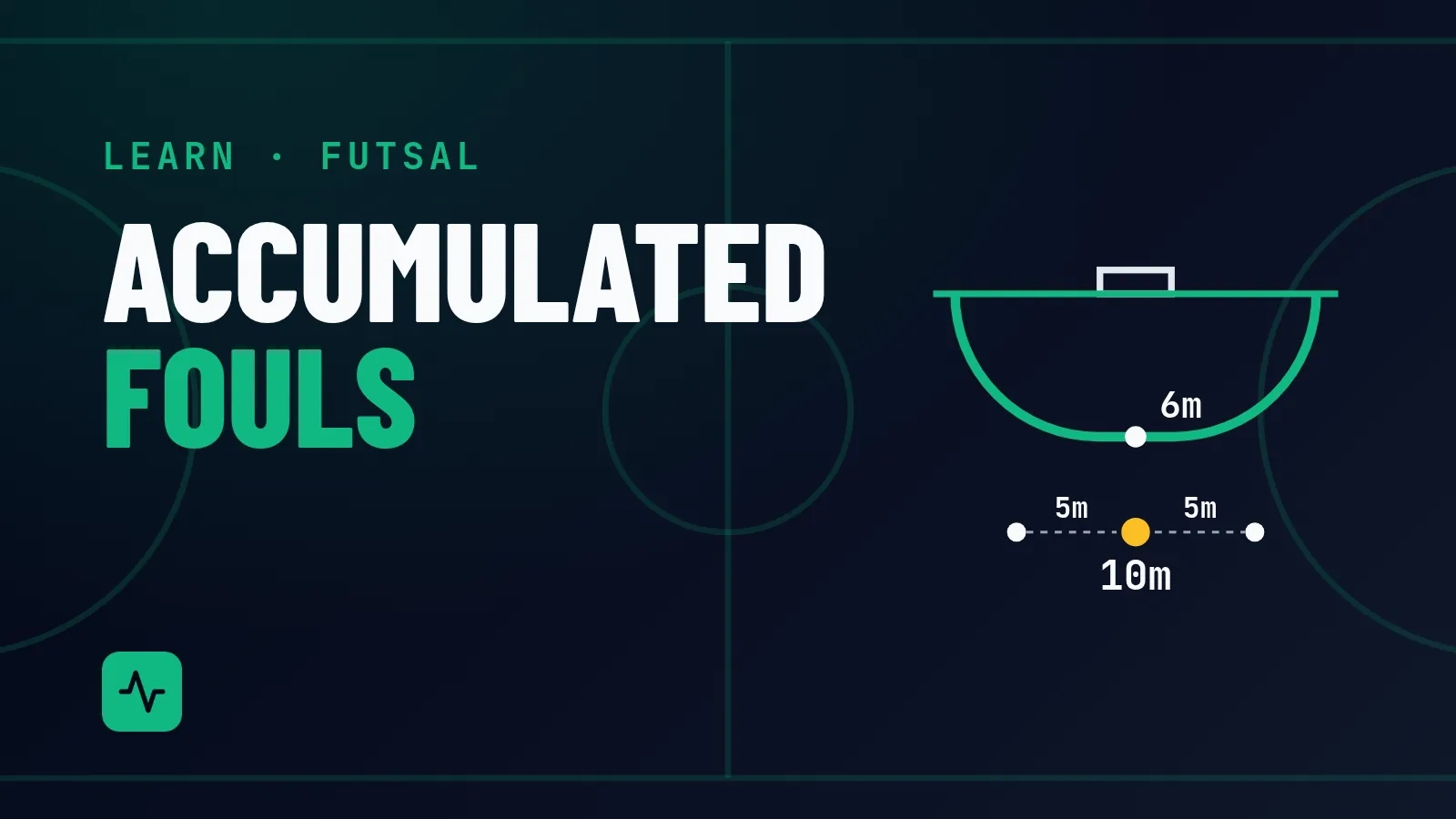
In futsal, the referees count each team's fouls in every half. Only fouls that give a direct free kick count toward six. From your team's sixth in a half, each one gives the other team a direct free kick with no wall, or a penalty kick if it's inside your penalty area (Law 13.5). It's a rule that can change games.
Everything here comes from FIFA's Futsal Laws of the Game 2025-26 (effective 5 September 2025). The main rules are in Law 13 (Free Kicks), sections 4–6, with support from Laws 1, 6, 7 and 12. Local leagues can change some details, so check your competition rules too.
What is an accumulated foul?
An accumulated foul is a foul that gives the other team a direct free kick. A direct free kick is one you can score from straight away. Those fouls add to your team's count.
"Accumulated fouls are those penalised with a direct free kick, as specified in Law 3, Law 4 and Law 12."
Here is what goes on the count, and what doesn't:
- Direct-free-kick fouls count. Think kicking, tripping, pushing, holding, a deliberate handball and the other direct-free-kick offences in Law 12.1. Law 12.1 says: "All of the offences listed in this section count as accumulated fouls".
- Indirect-free-kick offences don't count. Examples are dangerous play without contact, or a goalkeeper holding the ball too long. Law 13.4 only counts fouls "penalised with a direct free kick".
- A foul that gives a penalty kick is not added. Law 12.1 says: "however, no accumulated foul is recorded when a penalty kick is awarded."
- Your bench can add to the count. "If a substitute, a sent-off player or a team official commits a direct-free-kick offence, this counts as an accumulated foul against their team." (Law 12.4)
- Playing on doesn't erase a foul. Sometimes referees let play continue because stopping would hurt the team that was fouled. That's called advantage. The foul still counts. The referees "should use the mandatory signals to indicate an accumulated foul to the timekeeper and third referee as soon as the ball is out of play" (Law 13.4).
Who keeps the count, and the "five fouls" warning
The count is official, and it goes in the match report. At matches with a full crew, the third referee keeps it. When your team reaches five fouls in a half, a sign goes on the timekeeper's table.
Law 13.4 says: "The accumulated fouls committed by each team in each period are recorded in the match report." Law 6.2 says the third referee "keeps a record of the accumulated fouls by each team signalled by the referees in each period of play" and "places a clearly visible sign on the timekeeper's table to indicate that a team has committed five accumulated fouls in one period of play".
Once you see that sign, the next direct-free-kick foul by that team is its sixth.
The 6th foul: a direct free kick with no wall (DFKSAF)
From the sixth foul in a half, the other team gets a free kick with no wall. The Laws call it a DFKSAF, short for "direct free kick beginning with the sixth accumulated foul". If the sixth foul happens inside the penalty area, it's a penalty kick instead.
Law 13.5:
"A direct free kick beginning with the sixth accumulated foul is awarded for the sixth accumulated foul and all subsequent such fouls committed by a team in each period. However, if the sixth or subsequent accumulated foul is committed inside the offender's penalty area, a penalty kick is awarded instead."
What that kick looks like, from Law 13.5:
- No wall. Defenders can't line up in front of the kick. "The defending team's players may not form a 'wall' to defend a DFKSAF."
- The kicker must shoot. "A goal may be scored directly from a DFKSAF and the kicker must attempt to do so." The kick has to be aimed at goal "with the intention of scoring a goal directly". A back-heel is allowed only if it's a real attempt on goal.
- Everyone knows who's kicking. "The player taking the DFKSAF must be clearly identified."
- The goalkeeper starts 5m back. "The defending goalkeeper must be at least 5m away from the ball until it has been kicked."
- Everyone else stays behind the ball. Other players must be "on the pitch", "at least 5m from the ball", "behind the ball" and "outside the penalty area."
- Four seconds to take it. Once the referees signal, "the kick must be taken within four seconds". If it isn't, "an indirect free kick is awarded to the opposing team".
- One touch for the kicker. "The kicker must not play the ball again until it has touched another player."
Where is the kick taken? The 10m mark and the "take it from the spot" option
The kick can be taken from a mark 10 meters from goal. The Laws call it the 10m mark. It's also called the "second penalty mark" or "second penalty spot", but that's a nickname. Law 1.5 describes it: "A second mark is made 10m from the midpoint between the goalposts and equidistant to them."
Law 13.5 gives two possible spots:
"The ball must be stationary with part of the ball touching or overhanging the centre of the 10m mark or at the place where the DFKSAF offence was committed (provided that this was in the area between the defending team's end line and the imaginary line outside the penalty area, 10m from and parallel to the end line)."
"If the DFKSAF offence was committed in this area, the kicker may choose to take the DFKSAF either from the 10m mark or from the place where the offence was committed."
In short, from Law 13.5:
- Foul inside the penalty area: "if the sixth or subsequent accumulated foul is committed inside the offender's penalty area, a penalty kick is awarded instead" (Law 13.5).
- Foul between the end line and an imaginary line 10m out: "the kicker may choose to take the DFKSAF either from the 10m mark or from the place where the offence was committed" (Law 13.5).
The court has extra marks to help everyone stand in the right place. There's a mark inside the penalty area "5m from the 10m mark, to ensure that the defending goalkeeper observes this distance" (Law 1.4). There are also two marks "at a distance of 5m either side of the 10m mark" to show the minimum distance for other players (Law 1.5).
What if the 6th foul happens as the half ends?
The half waits for the kick. Even if the clock runs out, the kick is still taken. "If a DFKSAF is awarded when a period is about to end, the period will be considered to have ended when the DFKSAF has been completed." (Law 13.5; Law 7.2 says the same for DFKSAFs and penalty kicks.) The kick is done when the ball stops or goes out of play, is played by anyone other than the defending goalkeeper, or the referees stop play for an offence by the kicking team.
Advantage after five fouls
Normally referees can let play go on to help the team that was fouled. Once a team has five fouls in a half, that changes. The referees may apply advantage only "if the offending team has not previously committed five accumulated fouls and the opposing team is not denied a goal or an obvious goalscoring opportunity" (Law 13.4). Law 12.3 adds that advantage "should not be applied" for a sixth or later accumulated foul "unless there is a clear opportunity to score a goal."
Do accumulated fouls reset at half-time?
Yes. Both teams start the second half on zero, however many fouls they had in the first half.
The count works "by each team in each period" (Law 13.5). The Futsal Terms section of the Laws defines the tally as "added up, starting from zero, in the first and second periods of the match."
What happens to accumulated fouls in extra time?
They don't reset for extra time. Your team carries its second-half count straight into extra time. If you finished the second half on four fouls, you start extra time on four.
Law 13.4:
"If extra time is played, accumulated fouls from the second period of the match continue to count during extra time."
Two more things to know about extra time. It's "two equal periods of extra time not exceeding five minutes each" (Law 10.2). And "There are no timeouts allowed during extra time, if played." (Law 7.3)
Youth futsal and local rules
Youth events can set some of their own rules, so check yours. US Youth Futsal (USYF) links to the FIFA Futsal Laws of the Game (2025-26) on its rules page. It also notes that its general overview "does not apply to all the USYF Events" and that event-specific rules can differ. Look in your league or tournament rules for changes, such as shorter periods. We haven't found a published youth-specific change to the accumulated-foul rule.
FAQ
What counts as an accumulated foul in futsal?
Any foul penalised with a direct free kick, including fouls by substitutes or team officials, counts. Indirect-free-kick offences don't. Under FIFA's Futsal Laws 2025-26 (Law 12.1), no accumulated foul is recorded when a penalty kick is awarded.
What happens on a team's 6th foul in futsal?
The opposing team gets a direct free kick with no defensive wall, called a DFKSAF in the Laws. The kicker must try to score, the goalkeeper must be at least 5m away, and every other player must be behind the ball and outside the penalty area (Law 13.5). If the foul is inside the offender's penalty area, a penalty kick is awarded instead.
Where is the 6th-foul kick taken from?
Law 13.5 of FIFA's Futsal Laws 2025-26 says the ball must be on "the centre of the 10m mark or at the place where the DFKSAF offence was committed (provided that this was in the area between the defending team's end line and the imaginary line outside the penalty area, 10m from and parallel to the end line)." If the foul was in that area, "the kicker may choose" either spot. A sixth foul inside the offender's penalty area is a penalty kick instead.
Do futsal accumulated fouls reset at half-time?
Yes. Each team's tally starts from zero in the first period and again in the second period, according to the Futsal Terms in FIFA's Futsal Laws of the Game 2025-26.
Do accumulated fouls carry into extra time?
Yes. Under Law 13.4, "accumulated fouls from the second period of the match continue to count during extra time." They don't reset to zero for extra time.
How do I know when a team has five fouls?
At matches with a third referee, a clearly visible sign goes on the timekeeper's table when a team reaches five accumulated fouls in a period (Law 6.2). The timekeeper's duties include "recording the goals, accumulated fouls and periods of play on the public scoreboard" where one is available.
Sources
| Document | Edition / year | Link | Sections used |
|---|---|---|---|
| FIFA, Futsal Laws of the Game 2025-26 | 2025-26, effective 5 September 2025 (approved by the Bureau of the Council) | https://digitalhub.fifa.com/m/20d52e6779b53321/original/FUTSAL-Laws-of-the-Game-2025-2026.pdf | Law 1.4 (penalty area, 5m mark), Law 1.5 (10m mark); Law 6.2 (third referee/timekeeper duties); Law 7.2 (ending periods), 7.3 (timeout); Law 10.2 (extra time); Law 12.1 (direct free kick), 12.3 (advantage), 12.4 (restart after fouls and misconduct); Law 13.4 (accumulated fouls), 13.5 (DFKSAF), 13.6 (summary table); Futsal Terms ("Accumulated foul") |
| US Youth Futsal, Futsal Rules page | Web page accessed 2026-10-10 (the overview text is marked "11-2020") | https://www.usyouthfutsal.com/the-rules | Links to FIFA Laws 2025-26; overview disclaimer |
PlayHub tracks futsal goals, shots, saves and each team's accumulated fouls per half, live from the sideline.