Last reviewed
Futsal positions explained: pivot, ala, fixo and goalkeeper
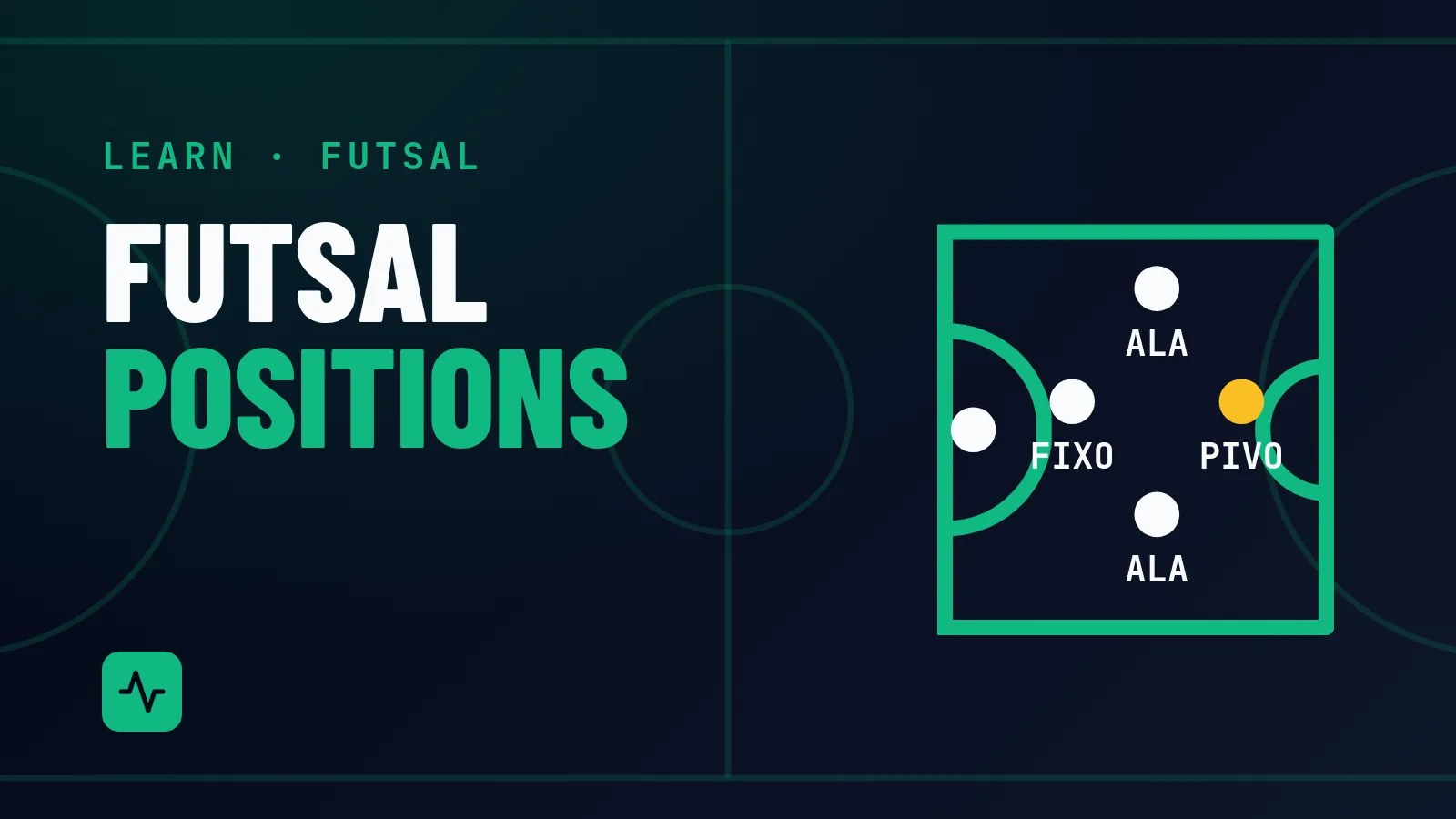
At a futsal game you may hear a coach yell "pivot!" or "fixo, drop!" These are position names. Here's what each one means, in the words of U.S. Soccer and FIFA.
First, one thing to know: the Futsal Laws of the Game do not define these positions. A full-text search of FIFA's Futsal Laws of the Game 2025-26 finds no "pivot", "ala", "fixo", "winger" or "defender" as a position. The Laws only require that each team has a goalkeeper. The names pivot, ala and fixo are coaching terms, not law; the role descriptions below are quoted from U.S. Soccer and FIFA coaching sources. Where something is a rule (mostly about the goalkeeper), we quote the Laws directly.
For other futsal terms, see the futsal glossary. For how futsal's five-a-side format compares with soccer, see futsal vs soccer.
What the Laws require: five players, one goalkeeper
Your team has up to five players on the court, and one must be the goalkeeper. That's the only position the rules ask for. The Laws don't assign roles to the other four.
"A match is played by two teams, each with a maximum of five players, one of whom must be the goalkeeper." (FIFA Futsal Laws 2025-26, Law 3.1)
Futsal positions explained: fixo, ala and pivot
The four players who aren't in goal are the outfield players. U.S. Soccer's men's futsal national team roster gives a one-line key to the three outfield position names. It spells the forward position "Pivo"; this page also uses "Pivot", as FIFA's coaching manual does.
"Fixo = Defender; Ala = Winger / Midfielder; Pivo = Target / Forward" (U.S. Soccer, men's futsal national team page, June 2026 roster key)
FIFA's own Futsal Coaching Manual (2024) uses English names, and explains why:
"Like in football, futsal players can be defined according to the positions they occupy on the pitch: goalkeeper, defender, winger and pivot/forward. Whilst these positions have often had terms and references applied to them from the Spanish language, these are not always reflective of their intended meaning when translated around the world in other languages."
| Name | U.S. Soccer key | FIFA Coaching Manual term |
|---|---|---|
| Fixo | Defender | Defender |
| Ala (plural: alas) | Winger / Midfielder | Winger |
| Pivot (U.S. Soccer: "Pivo") | Target / Forward | Pivot/forward |
| Goalkeeper | — | Goalkeeper (the only position the Laws mention) |
Fixo (defender)
U.S. Soccer's key says "Fixo = Defender". FIFA's manual describes the defender as "the deepest (and generally last) defender on the penultimate defensive line. In traditional futsal nations, this position may be referred to as the 'fixo', but this term has different meanings in different languages, so a more standardised term is required." It adds: "This is usually the player who will mark the pivot depending on out-of-possession structure and positional recovery."
Ala (winger)
U.S. Soccer's key says "Ala = Winger / Midfielder". FIFA's manual calls the position "winger" and says: "The role of the winger is primarily to offer width, as the name of this position implies." It also describes the "inverted winger", "used to describe left-footed wingers playing on the right and vice versa."
Pivot (pivot/forward)
U.S. Soccer's key says "Pivo = Target / Forward". FIFA's manual describes the pivot as "the player furthest forward in an attacking 3-1 formation or even as the spearhead in a 1-3 formation". A FIFA Training Centre session on the 3-1 system says the pivot "looks to hold the ball up and combine with team-mates or turn to take a shot on goal."
Formations you'll hear about
A formation is described by the outfield players only. A "3-1" is the system FIFA's manual uses when it describes the pivot as the player furthest forward. The manual mentions "1-3, 3-1, 2-2 and 4-0 systems which will all be used within the same phases of the game".
Do youth players need fixed positions?
The Laws don't require positions for youth players. FIFA's manual notes that position specialists matter "Not so much at the developing player or youth player phase of development, but as players transition into adult play".
The goalkeeper: what the Laws actually say
The goalkeeper is the one position with its own rules. All quotes below are from FIFA's Futsal Laws of the Game 2025-26.
Kit. Your goalkeeper has to stand out from everyone else on the court. "Each goalkeeper must wear colours that are distinguishable from those of the other players and the match officials." (Law 4.3) "Goalkeepers may wear trousers." (Law 4.4)
Handling. Outside the penalty area, the Laws treat the goalkeeper like any other player when it comes to handling. "The goalkeeper has the same restrictions on handling the ball as any other player outside the penalty area." (Law 12.1)
Four seconds. Your goalkeeper can't keep the ball in your own half for more than four seconds. If they do, the other team gets an indirect free kick. An indirect free kick is awarded if a goalkeeper "controls the ball with the hands, arms or feet in their own half of the pitch for more than four seconds" (Law 12.2). More in our guide to rolling substitutions and the 4-second rule.
Back-passes and second touches. There are limits on the goalkeeper touching the ball again after a teammate plays it back. An indirect free kick is also awarded if a goalkeeper:
- "after having played the ball in controlled possession, wherever on the pitch, touches it again in their own half of the pitch after it has been deliberately played to the goalkeeper by a team-mate without an opponent playing or touching it; there is no disciplinary sanction;"
- "touches the ball with the hands or arms inside their own penalty area after it has been deliberately kicked to the goalkeeper by a team-mate (including from a kick-in);" (Law 12.2)
Goal clearances. When the ball goes out over the end line off an attacker, your goalkeeper restarts by throwing it. "The ball is thrown or released from any point within the penalty area by the goalkeeper of the defending team." (Law 16.1)
Youth throwing limits. Some youth leagues don't let goalkeepers throw the ball straight over the halfway line. The Laws allow leagues to set this. An indirect free kick is awarded if a goalkeeper, "where this is outlawed by domestic rules for youth, veterans', disability and/or grassroots futsal, throws the ball directly over the halfway line" (Law 12.2). Check your league rules.
The flying goalkeeper (power play)
Your team can swap its goalkeeper for a field player in a goalkeeper's shirt, so the goalkeeper can play as an extra outfield player. This is called a flying goalkeeper. It can leave your own goal empty.
FIFA's Futsal Terms define a flying goalkeeper as "A goalkeeper who (temporarily) plays as an outfield player, often stationed in the opponents' half and leaving the goal unguarded. This role may be performed by the team's regular goalkeeper or another player brought on to replace the usual goalkeeper specifically for this purpose".
The rules for the swap are in Law 3.6. A substitute can swap in at any time. A player already on the court has to wait for a stoppage and tell the referees.
- "Any of the substitutes may change places with the goalkeeper without informing the referees or waiting for a stoppage in the match."
- "Any player may change places with the goalkeeper; however, this player must do so during a stoppage in the match and must inform the referees before the change is made."
- "A player or substitute replacing the goalkeeper must wear a goalkeeper's shirt with the player or substitute's own number on the back. Competition rules may also stipulate that a player acting as a flying goalkeeper must wear exactly the same colour as the main goalkeeper's shirt."
"Power play" is a coaching term, not a Law term. FIFA's coaching manual notes it is "not specifically referenced as this within Law 3.6".
FAQ
Do the Futsal Laws of the Game define pivot, ala and fixo?
No. FIFA's Futsal Laws of the Game 2025-26 don't define any outfield position. Law 3.1 only says each team has "a maximum of five players, one of whom must be the goalkeeper" on the court at once. Pivot, ala and fixo are common coaching terms.
What is a pivot in futsal?
U.S. Soccer's roster key lists "Pivo = Target / Forward". FIFA's Futsal Coaching Manual describes the pivot as "the player furthest forward in an attacking 3-1 formation". It's a coaching term, not a rule.
What is an ala in futsal?
U.S. Soccer's roster key lists "Ala = Winger / Midfielder". FIFA's Futsal Coaching Manual calls this position the winger, whose role "is primarily to offer width".
What is a fixo in futsal?
U.S. Soccer's roster key lists "Fixo = Defender". FIFA's Futsal Coaching Manual calls the position "defender" and notes it "may be referred to as the 'fixo'" in traditional futsal nations.
Can any player become the goalkeeper in futsal?
Yes, with conditions. Under Law 3.6 of FIFA's Futsal Laws 2025-26, a substitute can swap with the goalkeeper at any time; a player already on the pitch must do it "during a stoppage in the match" and tell the referees. The new goalkeeper "must wear a goalkeeper's shirt with the player or substitute's own number on the back."
How long can a futsal goalkeeper hold the ball?
No more than four seconds in their own half. Law 12.2 awards an indirect free kick if a goalkeeper "controls the ball with the hands, arms or feet in their own half of the pitch for more than four seconds".
Sources
| Document | Edition / year | Link | Sections used |
|---|---|---|---|
| FIFA, Futsal Laws of the Game 2025-26 | 2025-26, effective 5 September 2025 (approved by the Bureau of the Council) | https://digitalhub.fifa.com/m/20d52e6779b53321/original/FUTSAL-Laws-of-the-Game-2025-2026.pdf | Law 3.1, 3.6; Law 4.3, 4.4; Law 12.1, 12.2; Law 16.1; Futsal Terms ("Flying goalkeeper") |
| FIFA Global Football Development, Futsal Coaching Manual | © FIFA 2024 (PDF created December 2024), accessed 2026-10-10 | https://www.fifatrainingcentre.com/media/native/community-area-document/resources/futsal/FIFA_GFD_Futsal_Coaching_Manual_EN.pdf | Ch. 2 "The history of futsal" (positions); Ch. 11 "Futsal tactics" (systems of play; power play; role of the pivot; winger; defender) |
| FIFA Training Centre, "3-1 system: Role of the pivot" (Graeme Dell) | Web page dated 16 Jan 2024, accessed 2026-10-10 | https://www.fifatrainingcentre.com/en/practice/futsal/block-5/3-1-system-role-of-the-pivot.php | Session explanation (role of the pivot) |
| U.S. Soccer, "U.S. Men's Futsal National Team" | June 2026 detailed roster, accessed 2026-10-10 | https://www.ussoccer.com/teams/mens-futsal-national-team | Roster position key (Fixo / Ala / Pivo) |
PlayHub tracks futsal goals, shots, saves and each team's accumulated fouls per half, live from the sideline.