Last reviewed
Futsal vs soccer: what's actually different?
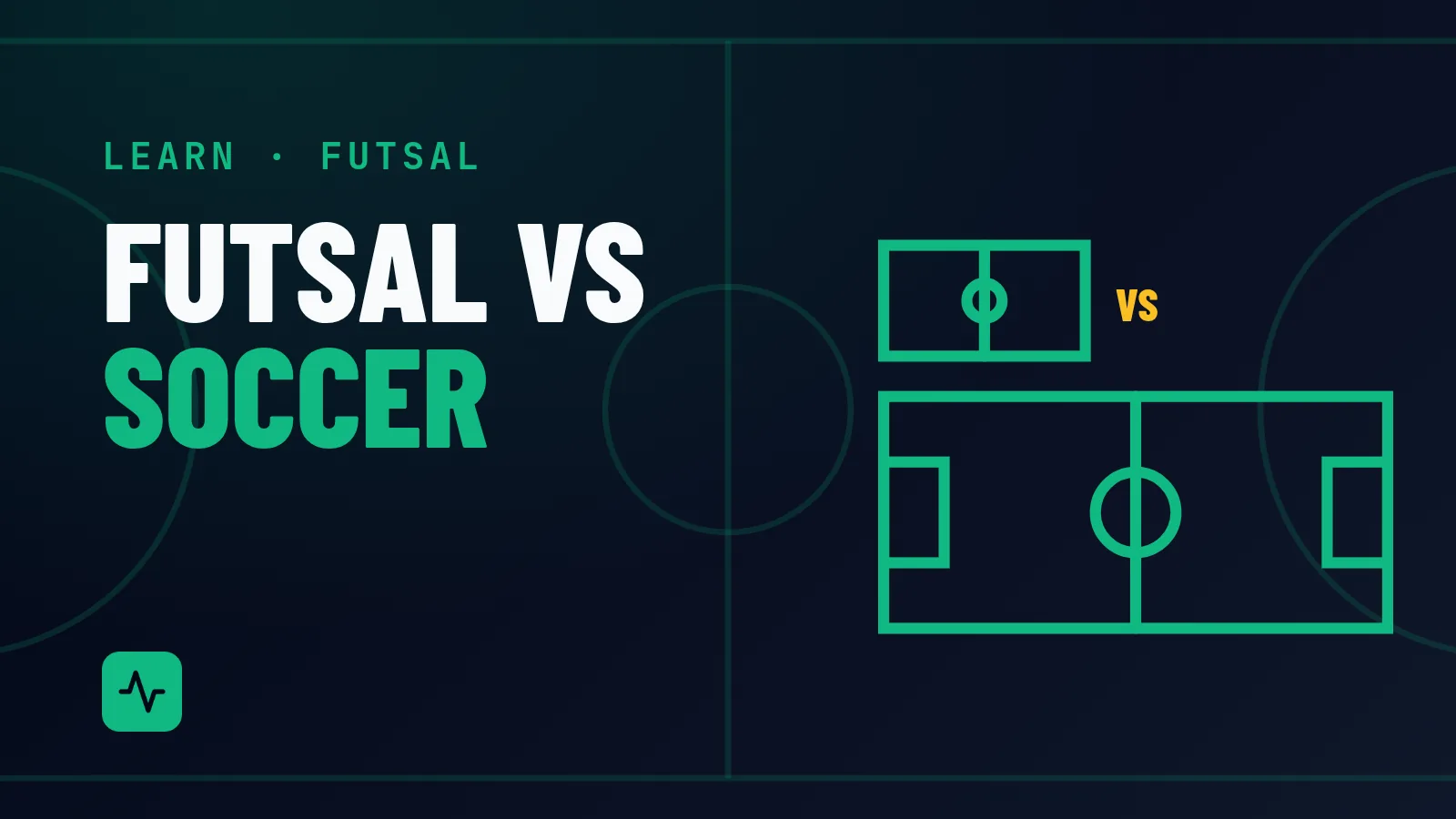
Futsal and soccer are close cousins. But the rulebooks differ on the ball, the pitch, how many players are on the field, the clock, substitutions and several restarts. This page puts the two side by side. Each section explains the difference first, then quotes the official text so you can check it.
- Futsal: FIFA, Futsal Laws of the Game 2025-26 (effective 5 September 2025).
- Soccer: The IFAB, Laws of the Game 2026/27 (effective 1 July 2026).
Leagues and tournaments can change some details (for example, period length, which competition rules may reduce), so check your competition rules too. New to the words? Keep our futsal glossary open in another tab.
Quick comparison
| Futsal (FIFA Futsal Laws 2025-26) | Soccer (IFAB Laws 2026/27) | |
|---|---|---|
| Ball circumference | "between 62cm and 64cm" (Law 2.1) | "between 68 cm (27 ins) and 70 cm (28 ins)" (Law 2.1) |
| Ball weight at kick-off | "between 400g and 440g in weight at the start of the match" (Law 2.1) | "between 410 g (14 oz) and 450 g (16 oz) in weight at the start of the match" (Law 2.1) |
| Pitch length (non-international) | touchline "Minimum 25m", "Maximum 42m" (Law 1.3) | touchline "minimum 90 m (100 yds)", "maximum 120 m (130 yds)" (Law 1.3) |
| Pitch width (non-international) | end line "Minimum 16m", "Maximum 25m" (Law 1.3) | goal line "minimum 45 m (50 yds)", "maximum 90 m (100 yds)" (Law 1.3) |
| Goal size | posts 3m apart; crossbar 2m from the floor (Law 1.9) | posts 7.32 m (8 yds) apart; crossbar 2.44 m (8 ft) from the ground (Law 1.10) |
| Players on the field at once | "a maximum of five players, one of whom must be the goalkeeper" (Law 3.1) | "a maximum of eleven players; one must be the goalkeeper" (Law 3.1) |
| Substitutes (official competitions) | "A maximum of nine substitutes may be used" (Law 3.2) | "up to a maximum of five" substitutes may be used (Law 3.2) |
| Minimum players | "start or resume": not with "fewer than three players" (Law 3.1) | "start or continue": not with "fewer than seven players" (Law 3.1) |
| Match length | "two equal periods of 20 minutes of playing time" (Law 7.1) | "two equal halves of 45 minutes" (Law 7.1) |
| Extra time (if used) | "two equal periods of extra time not exceeding five minutes each" (Law 10.2) | "two equal periods of extra time not exceeding 15 minutes each" (Law 10.2) |
| Substitutions | "An unlimited number of substitutions may be made during a match." Official competitions: "A maximum of nine substitutes may be used" (Law 3.2) | Official competitions: "up to a maximum of five" substitutes "may be used" (Law 3.2) |
| Offside | "There is no offside in futsal." (Law 11) | Offside applies (Law 11) |
| Ball over the touchline | Kick-in (Law 15) | Throw-in (Law 15) |
| Referees on the pitch | "two referees – the referee and the second referee" (Law 5.1) | "a referee" (Law 5.1) |
The rest of this page walks through each difference with the full quotes.
The ball
Futsal uses a smaller ball than soccer, with a slightly lower weight range. Its bounce is also set in the rules. Soccer's rules don't set a bounce.
FIFA's Futsal Law 2.1 says the ball must be "of a circumference of between 62cm and 64cm" and "between 400g and 440g in weight at the start of the match." The bounce test:
"The ball must not bounce lower than 50cm or higher than 65cm on the first rebound when dropped from a height of 2m." (Futsal Law 2.1)
For soccer, IFAB Law 2.1 says all balls must be "of a circumference of between 68 cm (27 ins) and 70 cm (28 ins)" and "between 410 g (14 oz) and 450 g (16 oz) in weight at the start of the match." The soccer Law has no bounce requirement.
Youth note: national associations can change the ball for youth futsal. FIFA lets them modify "The size, weight and material of the ball" for "youth, veterans', disability and grassroots futsal" (Futsal Laws, Notes – Modifications). Check your league's rules for youth ball sizes.
The court (pitch)
A futsal court is much smaller than a soccer field, and so are the goals. Futsal also has a few marks you won't see on a soccer field.
Surface. The Laws prefer a wooden floor. Futsal Law 1.1: "The surface of the pitch must be flat, smooth and non-abrasive, and should preferably be made of wood." Artificial turf is "permitted in exceptional cases but only for domestic competitions and if specified in the competition rules."
Size. For non-international futsal matches, Law 1.3 sets the touchline at "Minimum 25m" to "Maximum 42m" and the end line at "Minimum 16m" to "Maximum 25m". For international matches: touchline "Minimum 38m" to "Maximum 42m" and end line "Minimum 20m" to "Maximum 25m".
In soccer, IFAB Law 1.3 sets the touchline at "minimum 90 m (100 yds)" to "maximum 120 m (130 yds)" and the goal line at "minimum 45 m (50 yds)" to "maximum 90 m (100 yds)".
Goals. A futsal goal is 3m wide and 2m high. A soccer goal is 7.32m wide and 2.44m high. Futsal Law 1.9: "The distance (inside measurement) between the posts is 3m and the distance from the lower edge of the crossbar to the floor is 2m." Soccer, IFAB Law 1.10: "The distance between the inside of the posts is 7.32 m (8 yds) and the distance from the lower edge of the crossbar to the ground is 2.44 m (8 ft)."
Marks you won't see on a soccer field. Futsal has a penalty mark "6m from the midpoint between the goalposts" (Law 1.4), and a second mark "10m from the midpoint between the goalposts" (Law 1.5). That's the 10m mark used for sixth-foul kicks. Each bench has a substitution zone, "5m from the halfway line" and "5m in length" (Law 1.6). See rolling substitutions and the 4-second rule for how the zones are used.
Team size: players on the field and substitutes
The five-versus-eleven difference counts players on the field at one time, not the whole squad. Both rulebooks allow a team to bring substitutes as well.
Futsal Law 3.1: "A match is played by two teams, each with a maximum of five players, one of whom must be the goalkeeper. A match may not start or resume if either team has fewer than three players."
Soccer, IFAB Law 3.1: "A match is played by two teams, each with a maximum of eleven players; one must be the goalkeeper. A match may not start or continue if either team has fewer than seven players."
Futsal Law 3.2 sets the substitute limit: "A maximum of nine substitutes may be used in a match played in an official competition organised under the auspices of FIFA, confederations or national football associations. Competition rules must state how many substitutes may be named." Soccer's limit for official competitions is "up to a maximum of five" substitutes (IFAB Law 3.2). Other matches, including youth leagues, follow their competition's rules. Neither rulebook sets one overall roster size for a season. Your league or competition rules decide how many players can be on a team.
For what the five futsal players usually do, see futsal positions: pivot, ala and fixo.
Match length and the clock
A futsal game is two 20-minute halves of playing time, and a timekeeper runs the clock. Soccer is two 45-minute halves, and the referee adds time for stoppages.
Futsal Law 7.1: "The match lasts for two equal periods of 20 minutes of playing time, which may only be reduced if permitted by competition rules." A timekeeper ends each period: "The timekeeper signals the end of each period … with an acoustic signal that is different from the whistle used by the referees" (Law 7.2).
Soccer, IFAB Law 7.1: "A match lasts for two equal halves of 45 minutes, which may only be reduced if agreed between the referee and the two teams before the start of the match and if in accordance with competition rules." In soccer, "Allowance is made by the referee in each half for all playing time lost in that half" (Law 7.3). That's where stoppage time comes from.
Timeouts. In futsal, each team gets one one-minute timeout per half. "The teams are entitled to a one-minute timeout in each period." and "There are no timeouts allowed during extra time, if played." (Law 7.3). The IFAB Laws of the Game 2026/27 contain no timeout provision.
Half-time. Both codes cap half-time at 15 minutes. Futsal Law 7.4: "Players are entitled to an interval at half-time, not exceeding 15 minutes." Soccer, IFAB Law 7.2: "Players are entitled to an interval at half-time, not exceeding 15 minutes".
Main rule differences
Substitutions
In futsal, your team can sub as often as it likes, even while the ball is in play, and players can go back on. In soccer, official competitions allow up to five substitutes. Subs go on at a stoppage, and a player who comes off can't return, except where return substitutions are permitted.
Futsal Law 3.2: "An unlimited number of substitutions may be made during a match." Law 3.4: "A substitution may be made at any time, whether the ball is in play or not, except during a timeout" and "The player replaced may take further part in the match."
Soccer, IFAB Law 3.2: "The number of substitutes, up to a maximum of five, which may be used in any match played in an official competition will be determined by FIFA, the confederation or the national football association." Under IFAB Law 3.3, the substitute only enters "during a stoppage in play" and "at the halfway line", and the replaced player "takes no further part in the match, except where return substitutions are permitted". IFAB Law 3.2 adds: "The use of return substitutions is only permitted in youth, veterans, disability and grassroots football, subject to the agreement of the national football association, confederation or FIFA."
Offside
Futsal has no offside. Soccer does.
Futsal Law 11, in full: "There is no offside in futsal."
Soccer, IFAB Law 11.1: "It is not an offence to be in an offside position." A player in an offside position "is only penalised on becoming involved in active play" (Law 11.2).
Ball out over the touchline: kick-in vs throw-in
When the ball goes out over the touchline, futsal restarts with a kick and soccer with a throw. In futsal the ball also goes to the other team if it hits the ceiling. You can't score straight from either one.
Futsal: "A kick-in is awarded to the opponents of the player who last touched the ball when the whole of the ball passes over the touchline on the floor or in the air, or when the ball hits the ceiling while in play." (Futsal Law 15). The ball "must be stationary on the touchline", "all opponents must stand at least 5m" away, and "The ball must be put into play within four seconds of the team being ready to put the ball into play or the referee signalling that the team is ready to put it into play." (Law 15.1)
Soccer: the thrower must "throw the ball with both hands from behind and over the head from the point where it left the field of play", and "All opponents must stand at least 2 m (2 yds) from the point on the touchline where the throw-in is to be taken." (IFAB Law 15.1)
Both codes agree on one thing: "A goal cannot be scored directly from a kick-in" (Futsal Law 15) and "A goal cannot be scored directly from a throw-in" (IFAB Law 15).
Ball out over the end line: goal clearance vs goal kick
In futsal, the goalkeeper throws the ball back into play, and you can't score straight from it. In soccer, a defending player kicks it, and it can go straight in, but only at the other team's goal.
Futsal: "The ball is thrown or released from any point within the penalty area by the goalkeeper of the defending team." (Futsal Law 16.1) and "A goal may not be scored directly from a goal clearance." (Law 16)
Soccer: "The ball must be stationary and is kicked from any point within the goal area by a player of the defending team" (IFAB Law 16.1), and "A goal may be scored directly from a goal kick, but only against the opposing team" (Law 16).
Goalkeeper time limits
A futsal goalkeeper gets four seconds with the ball in their own half. A soccer goalkeeper gets eight seconds with the ball in their hands in the penalty area.
Futsal: an indirect free kick is awarded if a goalkeeper "controls the ball with the hands, arms or feet in their own half of the pitch for more than four seconds" (Futsal Law 12.2).
Soccer: "A corner kick is awarded if a goalkeeper, inside their penalty area, controls the ball with their hand(s)/arm(s) for more than eight seconds before releasing it." (IFAB Law 12.3)
Accumulated fouls
Futsal counts each team's fouls. From your team's sixth in a half, the other team gets a free kick with no wall (or a penalty kick if the foul is inside your penalty area). Soccer's Laws have no rule like this.
"Accumulated fouls are those penalised with a direct free kick, as specified in Law 3, Law 4 and Law 12." (Futsal Law 13.4). From the sixth in a period, "A direct free kick beginning with the sixth accumulated foul is awarded" and "The defending team's players may not form a 'wall' to defend a DFKSAF." (Law 13.5). The IFAB Laws of the Game 2026/27 contain no accumulated-foul rule. Full guide: futsal accumulated fouls explained.
Kick-off distance
At a futsal kick-off, opponents stand 3m away. In soccer it's 9.15m.
Futsal: "The opponents of the team taking the kick-off must be at least 3m from the ball until it is in play." (Futsal Law 8.1). Soccer: "the opponents of the team taking the kick-off must be at least 9.15 m (10 yds) from the ball until it is in play" (IFAB Law 8.1).
Referees
Futsal is controlled by two referees. Soccer is controlled by one.
Futsal Law 5.1: "Each match is controlled by two referees – the referee and the second referee – who have full authority to enforce the Futsal Laws of the Game in connection with the match." Futsal can also use "a third referee, a fourth referee and a timekeeper" (Law 6.1).
Soccer, IFAB Law 5.1: "Each match is controlled by a referee who has full authority to enforce the Laws of the Game in connection with the match."
FAQ
Is a futsal ball smaller than a soccer ball?
Yes. FIFA's Futsal Laws 2025-26 (Law 2.1) require a circumference "between 62cm and 64cm". The IFAB Laws of the Game 2026/27 (Law 2.1) require "between 68 cm (27 ins) and 70 cm (28 ins)" for soccer.
How long is a futsal game?
Under Law 7.1 of FIFA's Futsal Laws 2025-26, "The match lasts for two equal periods of 20 minutes of playing time, which may only be reduced if permitted by competition rules." Competition rules can shorten periods, so check your league's rules.
How many players are on a futsal team?
Five play at a time. Futsal Law 3.1 allows "a maximum of five players, one of whom must be the goalkeeper" on the pitch, and a match "may not start or resume if either team has fewer than three players." In official competitions, Law 3.2 adds that "A maximum of nine substitutes may be used". Soccer allows "a maximum of eleven players" on the field at once (IFAB Law 3.1). Overall roster size is set by competition rules, not by either rulebook.
Is there offside in futsal?
No. Law 11 of FIFA's Futsal Laws 2025-26 says: "There is no offside in futsal."
Do futsal players throw the ball in?
No. When the ball crosses the touchline or hits the ceiling, the restart is a kick-in from the touchline, taken within four seconds, with opponents at least 5m away (Futsal Law 15). Soccer uses a two-handed throw-in (IFAB Law 15).
Can futsal players come back on after being substituted?
Yes. Futsal Law 3.4 says "The player replaced may take further part in the match." In soccer, under IFAB Law 3.3, a replaced player "takes no further part in the match, except where return substitutions are permitted", and return substitutions are only permitted in youth, veterans, disability and grassroots football with approval (IFAB Law 3.2).
Sources
| Document | Edition / year | Link | Sections used |
|---|---|---|---|
| FIFA, Futsal Laws of the Game 2025-26 | 2025-26, effective 5 September 2025 (approved by the Bureau of the Council) | https://digitalhub.fifa.com/m/20d52e6779b53321/original/FUTSAL-Laws-of-the-Game-2025-2026.pdf | Notes (Modifications); Law 1.1, 1.3, 1.4, 1.5, 1.6, 1.9; Law 2.1; Law 3.1, 3.2, 3.4; Law 5.1; Law 6.1; Law 7.1–7.4; Law 8.1; Law 10.2; Law 11; Law 12.2; Law 13.4, 13.5; Law 15, 15.1; Law 16, 16.1 |
| The IFAB, Laws of the Game 2026/27 | 2026/27, effective 1 July 2026 | https://downloads.theifab.com/downloads/laws-of-the-game-202627-single-pages?l=en | Law 1.3, 1.10; Law 2.1; Law 3.1, 3.2, 3.3; Law 5.1; Law 7.1–7.3; Law 8.1; Law 10.2; Law 11.1–11.2; Law 12.3; Law 15, 15.1; Law 16, 16.1 |
PlayHub tracks futsal goals, shots, saves and each team's accumulated fouls per half, live from the sideline.